Andreas Altenburger (UiT the Arctic University of Norway)
The world is facing a biodiversity crisis. Species are going extinct at rates 100 to 1,000 times faster than the natural ‘background extinction rate’, outpacing the evolutionary processes that could replace the lost species. This current trend qualifies as a mass extinction event, a phenomenon that has occurred five times in Earth's geological history. The last mass extinction occurred around 66 million years ago, when the dinosaurs went extinct. Yet, one of the most pressing challenges today is that we do not fully understand what we are losing.
In the world’s oceans, it is estimated that 90% of species remain undiscovered and scientifically undescribed. This might seem counter-intuitive, as most visible marine species have already been named and described. So, where is this hidden diversity? The answer lies in two key areas: the deep sea, which is difficult to access, and the microscopic world, which cannot be observed without specialised tools such as microscopes.
About 90% of all species on Earth are smaller than a human fingernail on the little finger. Tiny organisms often require microscopes for identification and represent an underappreciated component of global biodiversity. We classify these organisms based on their size as meiofauna—creatures smaller than 1 mm but larger than 32 µm. They inhabit all marine habitats, from the brine channels within sea ice to the interstitial spaces of the seafloor. Despite their size, meiofauna play a critical role in marine ecosystems, acting as a vital link in the food web. They consume bacteria, protists, and other microorganisms, and in turn serve as prey for larger organisms such as juvenile fish and invertebrates.
However, in the Arctic—a region disproportionately affected by rapid climate change—our knowledge of meiofauna is woefully inadequate. How many species exist? How are they distributed? And how might they be affected by the warming Arctic? Each scientific expedition to study these organisms raises more questions than answers. To address this critical knowledge gap, the UArctic Thematic Network on Arctic Marine Biodiversity was established to advance our understanding of Arctic biodiversity, with a particular focus on meiofauna.
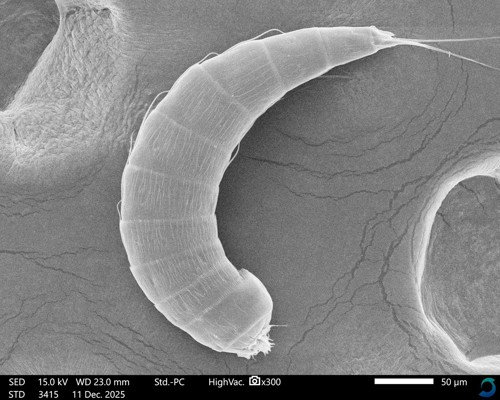
SEM image of a kinorhynch, the kind of meiofauna that we are exploring in the Arctic. Note the scale bar, which is 0.05 mm. So the organism is about 300 µm or 0.3 mm long.
The Thematic Network on Arctic Marine Biodiversity was founded in 2022 at UiT The Arctic University of Norway and was officially accepted by the UArctic General Assembly in Quebec, Canada, in 2023. Initially comprising three partner institutions, the network has since grown to include ten partner institutions, with new collaborators continuing to join.
The network’s activities are centred around collaborative research and education. For research, joint scientific expeditions aboard UiT’s research vessel, RV Helmer Hanssen, have provided a strong foundation for collaboration Research cruise "HHUMTKT25" on R/V Helmer Hanssen successfully completed. These cruises provide opportunities for researchers and students to collect samples, share expertise, and develop innovative methodologies to study Arctic marine biodiversity. While the network initially focused on meiofauna, its scope has expanded to include other organism groups, such as bivalves Filip advances Arctic biodiversity research through Nordic collaboration.
Utilizing the North2North program, network members could visit participating network institutions North2North staff mobility to the Greenland Institute of Natural Resources (GINR) for the exploration of Greenlandic meiofaunal flatworms. Collaboration in Greenland, led to new insights into speciation of Arctic flatworms Flatworms thrive at the public beaches of Tromsø – but how do they spread across the Arctic? and Recent postglacial population expansions may explain a surprising lack of lineage splitting in Arctic meiobenthic flatworms | BMC Ecology and Evolution | Springer Nature Link.
Also for Arctic meiofauna, network members have published important results A big step towards understanding the biodiversity of Arctic meiofauna.

Collaboration lies at the heart of the network. Members contributed to the Arctic Future Pathfinders course, which brought together over 130 participants, including students, researchers, and Indigenous knowledge holders, to address the Arctic’s challenges and opportunities. Although ice conditions disrupted the planned sailing expedition through the Northwest Passage, the course successfully adapted to land-based activities in Arctic communities, enriching the overall experience Arctic Future Pathfinders: A transformative journey through the Arctic.
The network also organises the ScaliFar PhD and Master’s course in the Faroe Islands this summer. The course will focus on the systematics, morphology, and ecology of meiofaunal scalidophoran taxa. This one-week field course combined practical fieldwork, lab exercises, and lectures, will equip students with essential skills for Arctic biodiversity research ScaliFar 2026 - A Scalidophora PhD and Master’s course in the Faroe Islands.
Outreach is another key focus, with initiatives like "Wednesday at the Museum" at the Arctic University Museum of Norway. These monthly evening events combine science, culture, and social interaction, offering activities such as knitting cafés, creative workshops, and talks. By contributing to an inclusive and engaging space, the network aims for connections between Arctic research and the wider community Wednesday at the museum - A concept of experiencing the museum at night.
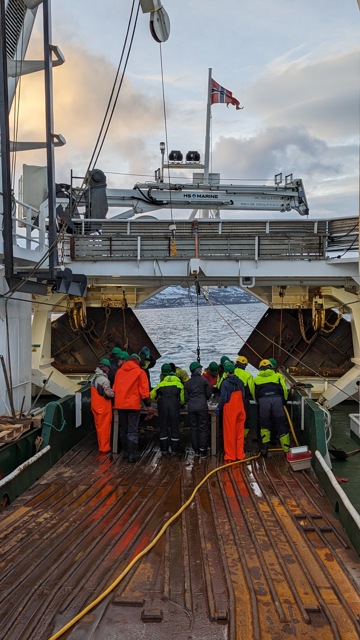
Working on board a vessel in the Arctic. Photo:
One of the network’s unique features is its cross-disciplinary approach, which integrates cutting-edge technologies into biodiversity research. A prime example is the use of X-ray microscopy at Luleå University of Technology. This advanced imaging technique enables researchers to create high-resolution, three-dimensional digital specimens of microscopic organisms.
This innovation is important for meiofauna research. Molecular characterisation methods often destroy the physical specimen, making it challenging to preserve and study these tiny creatures. By creating digital specimens, researchers can document and share detailed morphological data without compromising the integrity of the original sample. These digital specimens also serve as a valuable resource for education, allowing students and scientists worldwide to explore Arctic biodiversity in unprecedented detail.
The network relies on continuous funding through national UArctic funding schemes and is deeply grateful for the support received so far.
We are open to welcoming new members and look forward to fostering new collaborations on research and educational projects.
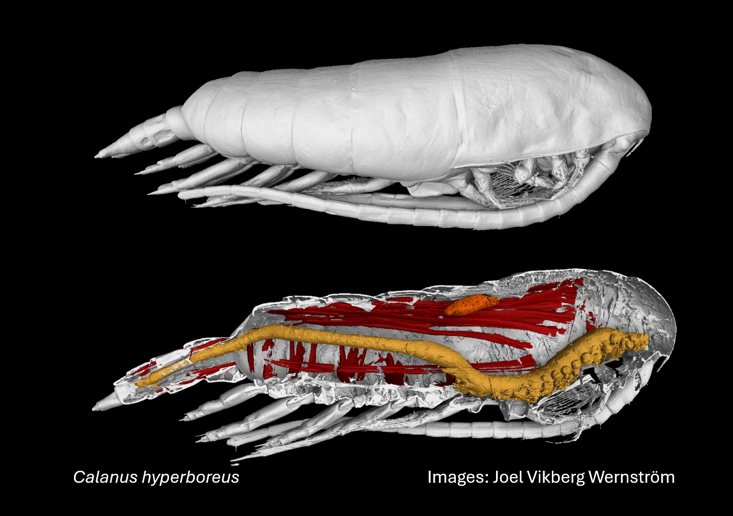
X-ray microscopy image of Calanus. Images: Joel Vikberg Wernström.
