The strength of the University of the Arctic's Arctic Sustainable Arts and Design (ASAD) network lies in its ability to connect people, places, and knowledge traditions across generations and cultural contexts.
Founded in 2012, ASAD has grown into an international community of artists, designers, educators, researchers, and cultural practitioners throughout the circumpolar North. As the network continues to evolve, one of its most significant achievements is the continuity of knowledge, values, and relationships that have shaped its work for more than a decade.
A central figure in this development has been Professor Emeritus Timo Jokela, founder and long-time leader of ASAD. Throughout his career, Jokela has worked simultaneously as an artist, educator, researcher, and community collaborator. His contribution to Arctic art and art education extends beyond scholarship to include the cultivation of communities, partnerships, and learning environments through which knowledge is shared across generations.
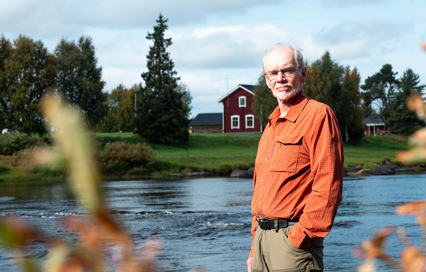
Timo Jokela and Ounas River. Photo: Aki Lintumäki, 2024.
In many ways, Jokela has exemplified a dual role that is increasingly recognised as important in Arctic knowledge systems: that of both academic scholar and local knowledge holder. Rooted in the ecocultural landscapes of northern Finland, particularly the Ounasjoki River Valley, his work demonstrates how local experience, environmental relationships, artistic practice, and scholarly inquiry can enrich one another. Through ASAD, these perspectives have been brought into dialogue with partners across the circumpolar North.
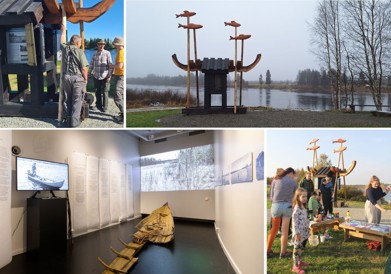
Timo Jokela, Meän vapaa Ounas -teos (Our Free Flowing Ounas River), 2024, Köngäs. Photos: Timo Jokela, 2024.
Today, ASAD's commitment to knowledge continuity is becoming visible in new ways. As leadership and responsibilities are increasingly shared among new generations of researchers and educators, the network continues to facilitate encounters between Indigenous knowledge holders, Elders, artists, educators, researchers, and students.
A recent example took place in northern Norway during a workshop led by Professor Gunvor Guttorm from the Sámi University of Applied Sciences. The event was initiated and facilitated by a newer ASAD member, curator Anja Kath Lande of the Adde Zetterquist Art Gallery in Junkerdal, Norway, bringing together participants from Finland, Norway, and across Sápmi.
The workshop focused on traditional root-weaving techniques and the harvesting of natural materials. Root weaving is a shared craft tradition practiced traditionally across many communities. Participants learned how roots are gathered, prepared, and woven using methods developed over generations.
While teaching this shared craft tradition, Guttorm also introduced participants to perspectives derived from duodji, the Sámi tradition of making and knowing through craft. Her teaching demonstrated how practical skills are intertwined with storytelling, lived experience, environmental understanding, and cultural memory. Participants heard also about relationships between materials, seasons, places, communities, and responsibilities towards the environment.
The workshop highlighted how knowledge is carried through practice, observation, stories, and intergenerational learning. Such approaches have significantly influenced contemporary discussions on Arctic art, sustainability, material relationships, and place-based education. At the same time, participants were reminded of an important principle: while many Arctic artists and educators can learn from Indigenous knowledge systems and material practices, duodji remains a distinct Sámi cultural tradition. Its meanings, knowledge systems, and future development must be approached with respect for Sámi cultural rights, agency, and self-determination.
For ASAD, the workshop demonstrated how cultural knowledge can be introduced responsibly while acknowledging different forms of cultural ownership, expertise, and lived experience. It also illustrated how learning environments can bring together Indigenous and non-Indigenous participants in respectful dialogue and collaborative learning.
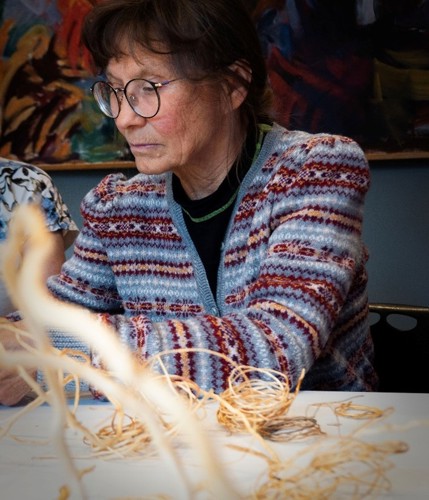
Gunvor Guttorm teaching root craft. Photo: Bjørnar Meisler, 2026.
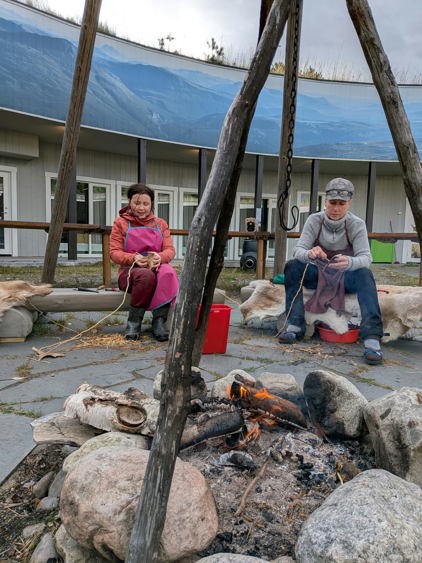
Maria Huhmarniemi and Anja Kath Lande working with roots. Photo: Tommi Yläjoki, 2026.
Since its establishment, ASAD has created multiple platforms through which knowledge, ideas, and practices circulate across the circumpolar North. The network's best-known initiative is the annual Relate North Symposium and Exhibition, which brings together artists, researchers, educators, students, and community partners from across Arctic regions to share research, artistic work, and educational innovations.
Hosted by different network partners each year, Relate North has become an important forum for dialogue, peer learning, and international collaboration. Beyond the symposium, ASAD has produced a substantial body of publications, exhibition catalogues, and research outputs that document and disseminate northern knowledge and creative practices.
The network has also supported numerous community-based art education projects, workshops, summer schools, and collaborative initiatives that connect universities with local communities. They are presented in the New Genre Arctic Art Education website. Through these activities, ASAD has fostered long-term relationships between institutions, researchers, artists, and communities while creating opportunities for knowledge exchange across generations, cultures, and disciplines.
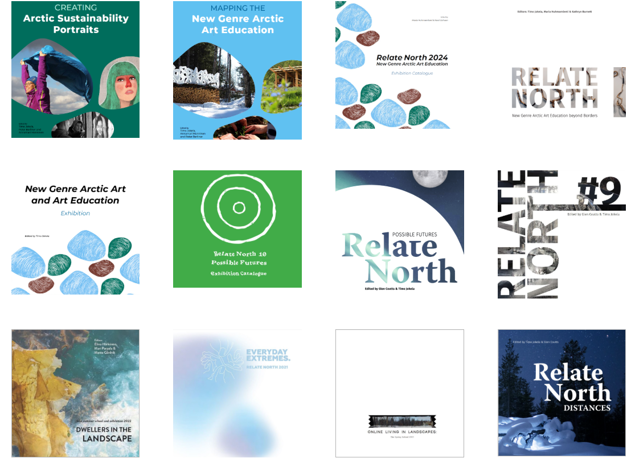
ASAD collaborations are shared in various publications available in the ADAD website.
Knowledge continuity is also reflected in the evolution of the network's leadership. Glen Coutts was among the key figures involved in establishing the the ASAD network in 2012 and subsequently led its Applied Visual Arts Special Interest Group for several years. Timo Jokela served as the leader until 2024.
Today, ASAD is led by Maria Huhmarniemi, who also serves as UArctic Chair in Arctic Art and Design. Having participated in the network since its establishment, she represents both continuity and renewal within ASAD.
Huhmarniemi's work focuses particularly on projects that bring together different ways of knowing and forms of expertise. Her interests include collaborations between artists, scientists, local communities, Indigenous knowledge holders, and environmental researchers. Through such initiatives, ASAD continues to expand the role of art and design in addressing environmental, social, and cultural challenges across the Arctic.
The network's activities are further supported by Vice-Leads Cindy Kohtala and Hanna Ólafsdóttir, together with numerous research collaborations, educational initiatives, and community partnerships throughout the circumpolar North.
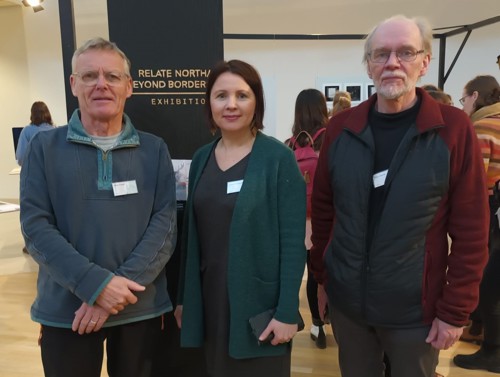
Glen Coutts, Maria Huhmarniemi and Timo Jokela in the Relate North exhibition in Umeå, Sweden, 2023.
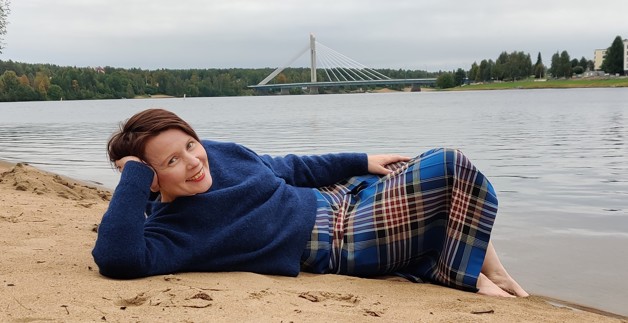
Maria Huhmarniemi in Rovaniemi, 2024.
As ASAD continues to evolve, encounters across cultures, disciplines, and generations remain central to its contribution to Arctic education, art, and sustainability. Its future is sustained through the sharing of knowledge across communities and through the networks of trust and collaboration built over many years.
In this respect, long-term members such as Timo Jokela and Gunvor Guttorm exemplify an important Arctic model of leadership. Both have served simultaneously as respected scholars and as carriers of cultural and place-based knowledge. Their work demonstrates how academic research, artistic practice, and community knowledge can enrich one another. Through these dual roles, they have helped create pathways through which knowledge, values, and responsibilities are passed on to future generations.
The story of ASAD is therefore also a story of continuity: from pioneering members to a new generation of researchers, artists, educators, and community practitioners who will continue shaping Arctic knowledge, creativity, and collaboration for years to come.
Looking ahead, ASAD remains open to new members. As the University of the Arctic expands, new member institutions and their representatives are encouraged to join the network.
The continued involvement of new participants ensures that ASAD remains a vibrant platform where knowledge, skills, and ideas are shared across generations, cultures, disciplines, and regions of the circumpolar North.
More information:
Maria Huhmarniemi: maria.huhmarniemi@ulapland.fi
Thematic Network on Arctic Sustainable Arts and Design (ASAD)
New Genre Arctic Art Education
