
ASAD collaboration and Arctic art education presented in the Education in the North

Annamari Manninen (University of Lapland) and Karin Stoll, Wenche Sørmo, and Mette Gårdvik (Nord University, Nesna Campus) have authored the article “Arctic art education in collaboration - creating dialogues for learning,” published in the journal Education in the North.
The article examines the development of a shared hybrid university course designed to foster dialogue between Arctic communities, children and youth, teacher students, university staff, and local cultural actors. The course integrates contemporary art practices with Indigenous and regional knowledge to explore sustainability from Arctic perspectives. Based on students’ reflections, the article identifies key elements of Arctic Art Education learned in the Nomadic Hub course and shows how art-based action research supports cross-border collaboration, meaningful remote encounters, and ecoculturally grounded, transformative learning.
The current issue of Education in the North also includes several other articles by artist-researchers active in the ASAD network, presenting the new genre of Arctic Art Education developed through ASAD collaborations. Korinna Korsström-Magga and Mirja Hiltunen contribute “Rievdan - new genre Arctic art education building cultural resilience in a time of global change,” which describes an art-based action research project in Sápmi conducted in collaboration with communities in Finland and Norway. The study highlights the culturally sensitive and ethical approaches needed when conducting co-research in pluriversal northern contexts.
Maria Huhmarniemi, Fabiola Hernández Cervantes, and Hanieh Ahmadi authored “Felted Futures: crafting transformative learning experiences in the Arctic.” The article discusses project-based higher education in which teachers, researchers, and international students revitalised a traditional felting technique to support rural communities and circular economy goals. Their work demonstrates how culturally rooted craft practices can inform sustainable design, the bioeconomy, and transformative art and design education in the Arctic.
Marija Griniuk contributes “Art history techniques and Sámi pedagogy in Norway: connecting art history, tradition and nature,” which explores how Sámi pedagogy and art history teaching can be combined in children’s workshops. Using A/R/Tography, the study recommends hands-on, eco-aware, community-engaged approaches grounded in Sámi culture.
These articles are part of the thematic issue “Arctic Futures: innovations in education for social justice and sustainability” in Education in the North. Together, they deepen understanding of how art education can foster intercultural and Indigenous knowledge and empower communities.
As the editors Outi Kyrö-Ämmälä, Tuija Turunen, Mhairi Beaton, Minna Maunula of the thematic issue state: “This special issue foregrounds practices and research that promote equitable, culturally responsive, and ecologically attuned education in the North.” Art education plays a strong role in this work.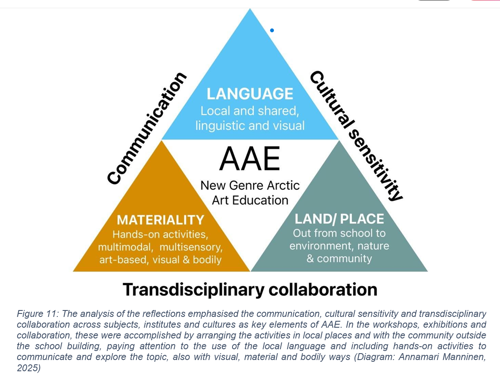
More information:
See documents of AAE practice on the site.
Current issues of the Education in the North.