
Book Chapter Published on the Development of Arctic Art Education within the ASAD Collaboration

Timo Jokela from the University of Lapland (Finland), Marija Griniuk from the Nordlandsmuseet (Norway), Mette Gårdvik from the Nord University (Norway) and Peter Berliner from the Association Siunissaq (Greenland) have co-authored a book chapter “The Lessons of the Land through the Nomadic Hub of New-Genre Arctic Art Education” published in the book “Relate North: Lessons of the Land.”
This chapter examines how Arctic art education is being reshaped through the University of the Arctic’s efforts to promote collaboration, interdisciplinarity, and engagement with Indigenous and multiethnic communities. It focuses on the New Genre Arctic Art Education (AAE) initiative, which seeks to bring together Western and Indigenous knowledge systems through a “two-eyed seeing” approach. This requires recognising differences in worldviews and educational traditions while also identifying where they can work together.
The AAE initiative involves a wide network of universities and local organisations from across the Arctic, ensuring strong participation from Indigenous and community-based partners. Its goal is to build a sustainable framework for art education that responds to the rapidly changing conditions of the North, supports contemporary and community engaged art, and connects research with the everyday lives of Arctic residents. Art education within the AAE is understood broadly: it includes work in schools, informal community settings, and professional training, all grounded in place-based learning and local knowledge.
The authors of the chapter describe that a central component of the initiative is the Nomadic Hub, a collaborative model developed within the ASAD-network. The Nomadic Hub promotes constant interaction among learners, educators, Land, materials, and communities. It combines online interactions with field-based activities, allowing participants to learn directly from local landscapes, traditions, and community members. The key guiding question of the chapter is how to integrate contemporary Arctic art, ecocultural knowledge, Western and Indigenous perspectives, and Land-Based Learning in diverse cultural settings.
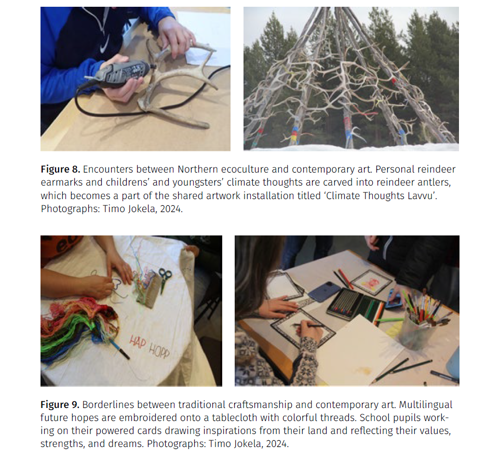
The chapter highlights the importance of working closely with local partners to ensure that activities reflect community values and knowledge. Elders, artists, and local practitioners play a vital role as knowledge-holders. Creative practices that use traditional materials, stories, and relationships with the Land help challenge the dominance of Western fine art traditions and support broader processes of decolonisation.
While place-based and Indigenous Land-Based Learning align in art educational practice, they also rest on different worldviews. The authors note that transferring Indigenous ecological practices outside their original cultural contexts requires care and cultural sensitivity. Authors also note that Arctic communities are living, changing societies, not static heritage sites.
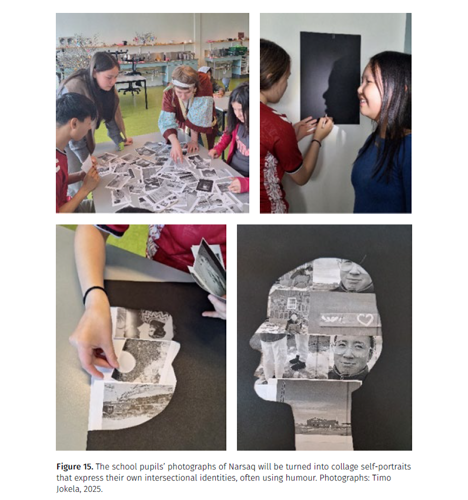
The chapter concludes that the Nomadic Hub has strong potential to evolve into a model for culturally grounded, ecologically aware, and socially inclusive art education. Future work should continue to deepen engagement with Indigenous and other Northern perspectives, ecocultural knowledge, and local sustainability challenges in order to support both community wellbeing and the transformation of Arctic art education.
More information:
See documents of AAE practice on the site: https://blogi.eoppimispalvelut.fi/ngaea/
The book chapter:
Jokela, T., Griniuk, M., Gårdvik, M. & Berliner, P. (2025). The lessons of the Land through the nomadic hub of wew-genre Arctic Art education. In M. Huhmarniemi, K. Burnett, & A. O’Grady (Eds.), Relate North: Lessons of the Land (pp. 66-97). InSEA Publications.
Find the publication online: https://www.asadnetwork.org/publications/