
Modelling Antarctic Subglacial Groundwater

Postdoctoral Research Fellow at the University of St Andrews Ryan M. Strickland was awarded a Scottish Arctic Network Arctic Travel and Partnerships Fund to collaborate with Dr. Thomas Zwinger, a computational scientist and glacier modeller at the CSC-IT Center for Science in Espoo, Finland. The visit focused on incorporating a newly-developed groundwater component into a 3D ice sheet model.
Did you know that groundwater exists beneath the Antarctic Ice Shet? As glaciers flow toward the sea, heat from friction and ice deformation produces meltwater at the glacier bed. This water lubricates the base of the glacier, helping the ice flow faster. However, some of this water is forced into layers of sediment and porous rock hundreds of metres below the ice, forming subglacial groundwater aquifers. This groundwater could play an important role in controlling how quickly glaciers will flow in the future.
The weight of the ice above and the pressure from the groundwater below exist in a delicate balance. When an ice sheet thickens, its increasing weight forces water deeper into the underlying aquifer, raising the pressure of the aquifer. But when the ice thins, that highly pressurised groundwater tries to escape back to the base of the ice sheet.
This creates an important feedback: thinning ice releases groundwater, the groundwater lubricates the bed, the ice flows faster, and the faster flow causes further ice thinning. Understanding whether this process could accelerate future ice loss is an emerging question in glaciology.
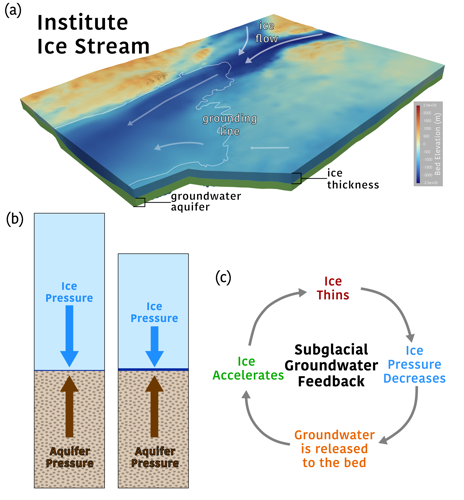
In March 2026, Ryan M. Strickland, a Postdoctoral Research Fellow at the University of St Andrews, was awarded a Scottish Arctic Network Arctic Travel and Partnerships Fund to collaborate with Dr. Thomas Zwinger, a computational scientist and glacier modeller at the CSC-IT Center for Science in Espoo, Finland. The visit focused on incorporating a newly-developed groundwater component into a 3D ice sheet model.
This collaboration marked the beginning of a project investigating the role of groundwater beneath the Antarctic Ice Sheet. Using newly acquired geological data, the project will explore how groundwater flow could influence ice loss from Institute Ice Stream in West Antarctica, one of the largest glaciers on Earth.
During the visit, Ryan and Dr. Zwinger worked together to construct the model framework and prepare simulations for simulations with upcoming datasets. As new field data become available after the 2026-27 and 2027-28 Antarctic field seasons, the model will become the first 3D investigation of how groundwater will influence the future of Institute Ice Stream and the West Antarctic Ice Sheet.
This article was originally published on the Scottish Arctic Network (ScAN) website. ScAN also operates as a UArctic Regional Centre. Link to original article: Modelling Antarctic Subglacial Groundwater – Scottish Arctic Network