
Student Story: Semin Bade Baran’s exchange at the University of Greenland in Nuuk is confirmed through UArctic’s north2north mobility program

Following her dream: Turkish Semin Bade Baran fell in love with both Winter and winter—literally. Now she brings her passion for sled dogs into her master’s work.
Turkish Semin was struck by “Arctic Fever”. Soon she will travel to Greenland on an exchange program to write her master’s thesis on the use of sled dogs in Arctic emergency preparedness—specifically in the Sirius Patrol.
“I’m very excited to see if I’ll be able to get in touch with the Sirius Patrol and actually speak with someone who has been out on assignment,” says Semin Bade Baran.
She is pursuing a master’s degree in Sustainable Leadership and Arctic Perspectives at Nord University, and her exchange with the University of Greenland in the capital Nuuk is now confirmed through UArctic's mobility program north2north.
From Nordlab to Greenland
This autumn semester, Semin chose HHN Internship Master as an elective and has an internship at the Center for Crisis Management and Collaboration- Nordlab.
“The purpose of the internship is to provide students with relevant work experience and professional networks before graduation. With us, Semin has gained practical experience in project work and learned what it’s like to work in a research environment focused on emergency preparedness and crisis management,” says Natalia Andreassen, professor at Nord University Business School, Nordlab and leader of UArctic Thematic Network on Arctic Safety and Security.
She emphasizes the value of participating in research seminars and networking events.
“I’ve also assisted during exercises at Nordlab,” Semin adds, thrilled with both her studies and internship.
Now she looks forward to being a student at the University of Greenland starting in February.
The Hunt for the Sled Dogs’ Inner Power…
Semin is often asked how a girl from a Mediterranean country ended up in the Arctic—and became completely hooked. It does not take long before she shows a photo of her snow-white best friend, the Greenland Dog Winter.
“He never became mine as planned,” she says.
Winter fell ill and died suddenly, but Semin continues her quest to uncover the sled dogs’ inner strength—the one deeply rooted in Inuit culture, passed down through generations like a secret. Her master’s thesis is titled “Non-human Actors in Arctic Emergency Preparedness”, and she wants to explore the phenomenon from both a two-legged and four-legged perspective.
…and the Hunt for the Sirius Patrol
Today, the Sirius Patrol monitors an enormous uninhabited area of Greenland—770,000 square kilometers, larger than France.
They patrol with dog sleds, often isolated for months at a time. They monitor illegal activity and also participate in search and rescue operations. Two soldiers and 11–15 Greenland Dogs live in extreme cold, covering thousands of kilometers during their missions, which typically last about two years. Semin is fascinated by what is considered one of the most demanding military services in the world, not least because they use traditional dogsledding in a modern military context. Is it necessary? What does Inuit knowledge contribute to preparedness that cannot be replaced by snowmobiles and drones?
Greenland Next
Semin Bade Baran will write her master’s thesis titled “Non-human Actors in Arctic Emergency Preparedness” and travel to Greenland to take a deep dive into the island’s use of sled dogs in emergency preparedness.
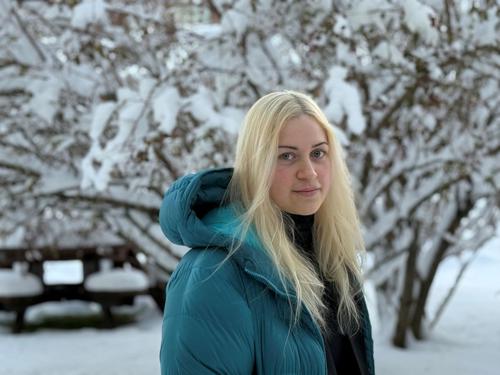
Photo by: Inger E. Eftevan Orvin
The Peaceful Cold
Semin’s Arctic journey began with curiosity as an art photographer. Eventually, dog sledding became part of the package, and she has worked as a tourist guide with dog teams in several northern regions.
On one of her trips, she ended up in Svalbard, where she was captivated by “the peaceful cold.”
“Not so many people. Just you on a lonely planet, spinning around in an Arctic reality,” she says, trying to put into words the experience that led her further—into an academic approach to dog sledding, the cold, and Arctic solitude.What About Technology?
“It will be incredibly exciting to see how they balance modern technology with generational knowledge. Do they combine rather than ignore? Why do they believe this is the best solution for the area they operate in?”
Semin still has many questions and few answers. Hopefully, her stay at the University of Greenland will open doors to more knowledge about a vast and little-discussed topic: the role of animals in emergency preparedness.
This article was written by Inger Ellen Eftevand Orvin and was originally published in an article on the Nord University website.