
SEDNA team hold their annual meeting at ASSW 2026 in Aarhus, Denmark

Members of the SEDNA and PermaIntern teams gathered in Aarhus, Denmark to hold their annual meeting in conjunction with the Arctic Science Summit Week (ASSW) 2026.
The conference provided the ideal event to showcase the programme’s achievements and advance collaborations on permafrost education, internships, and capacity building across the Arctic. ASSW 2026 brought together Arctic researchers, Indigenous representatives, students, and policy‑makers from 25 March to 1 April for a week of community meetings, workshops, a dedicated Science Day, and the Arctic Observing Summit.
The SEDNA delegation started the week by attending the morning ceremony in the Indigenous pavilion, which set the tone for a week grounded in dialogue, respect, and knowledge co‑production. This focus on Indigenous perspectives aligns closely with SEDNA’s objective to expand professional exchange opportunities for students and early‑career scientists, fostering equity, diversity, and inclusion through international placements.
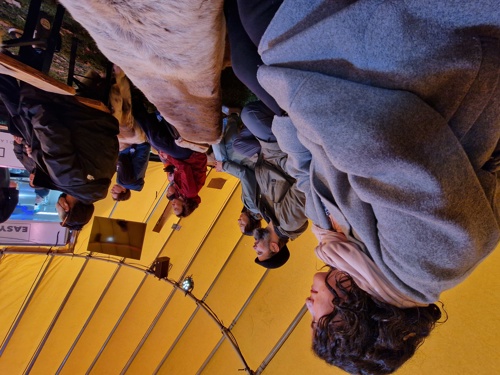
SEDNA team attending the morning ceremony in the Indigenous pavilion.
Photo: Tristan MacLean
On Saturday, the SEDNA/PermaIntern hosted its annual meeting, bringing together steering‑committee members, certified hosts, supervisors, and interns to review progress and plan upcoming activities. The agenda included updates on the growth of the pan‑Arctic internship platform, discussion of placements in 2025 and 2026, and reflections on lessons learned from the first cohorts of students and supervisors.
Permafrost internships were also visible during the ASSW Science Day on Sunday when Professor Hanne H. Christiansen delivered one of the day’s keynote talks, highlighting the importance of long‑term permafrost monitoring and the need for a new generation of specialists capable of working across disciplines and sectors. Her keynote underscored how internship programmes such as SEDNA and PermaIntern can help bridge gaps between observation networks, research institutions, and communities by giving students hands‑on experience with field measurements, data management, and engaging with a diverse range of people.
On Science Day, SEDNA and PermaIntern partners presented four posters showcasing different aspects of the internship initiative. The posters covered topics such as the outcomes of the SEDNA programme, development of the online platform, the permafrost education needs, and scientific findings from student placements in Canada. On the Arctic Observing Summit Day Julie Malenfant-Lepage presented the PermaIntern programme in the Shared Arctic Variables session on permafrost.
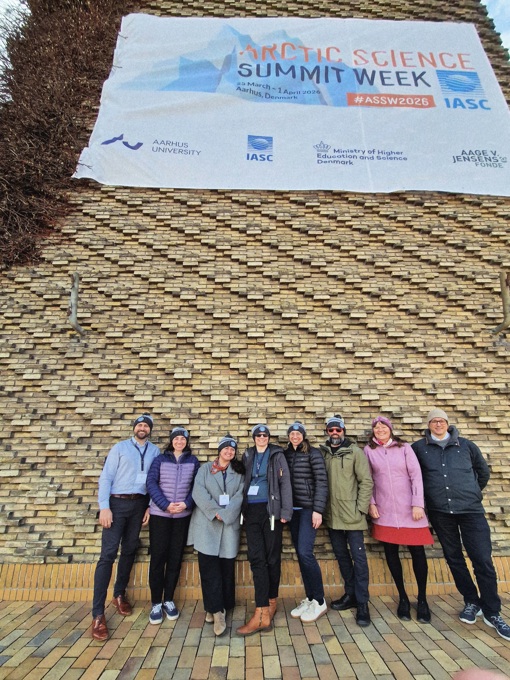
SEDNA team meet at the 2026 Arctic Science Summit Week. From left to right: Tristan MacLean, Stephanie Coulombe, Catalina Pino-Rivas, Ylva Sjöberg, Julie Malenfant-Lepage, Frédéric Bouchard, Hanne H. Christiansen, Thomas Ingeman-Nielsen. Photo: Tristan MacLean.
ASSW’s format, with several days dedicated to community meetings and side events before and after Science Day, provided additional opportunities for the SEDNA team to meet with collaborating organisations and potential new hosts. Informal discussions explored how the internship network could interface with other Arctic research and education initiatives. Team members also used the week to identify synergies with ongoing efforts in Arctic observing, infrastructure, and community‑driven research.
Overall, ASSW 2026 served as an important milestone for the SEDNA activities helping to consolidate SEDNA and PermaIntern’s role as a key platform for permafrost internships and training. The discussions and connections made in Aarhus will feed directly into plans for future seminars and expanded collaboration across the Arctic research community.
Supported by Memorial University and the University of the Arctic (UArctic) through the Global Arctic Leadership Initiative - Indigenous and Northern Collaborative Research and Education Fund, the SEDNA (Student Education, Development of professional skills and Networking across the Arctic) project brings together multiple permafrost professionals, research centers and groups, as well as governmental agencies and companies with the mission to provide opportunities for real-world experiences of professional work on permafrost. Building on previous work conducted across the Nordic region (PermaIntern 2022-2024), the SEDNA Permafrost Networking Platform integrates partners from Canada, including Northern/Indigenous community members.
Both projects are part of the activities of the UArctic Thematic Network on Permafrost.