
Celebrating Arctic Innovation at the 2025 Arctic Encounter Summit

ANCHORAGE, AK, APRIL 17 — Once a year, the Dena’ina Convention Center becomes a hub for global leaders, diplomats, researchers, and students that are excited about and invested in the Arctic. This audience comes to attend the Arctic Encounter Summit, the largest annual Arctic policy and business event in the United States.
This year, the UArctic Foundation US hosted both a booth and a panel at the Summit, celebrating the successes of the UArctic Entrepreneurship Fund and the young innovators that have received seed funds from the program. From the UArctic Thematic Network on Managing Small and Medium Sized Enterprises in the North, the UArctic Entrepreneurship Fund provides seed funds to support individuals with Arctic innovations. This seed grant program was created with private support from Michael Carey, allowing us to host an annual application to help incubator-stage projects take flight.
The Thursday panel was moderated by Brian D. Rogers, a founder and board treasurer of the UArctic Foundation US and a former chair of the UArctic Board of Directors. He was joined by three panelists, each one from a startup that received seed funding from the UArctic Entrepreneurship Fund. Hillary King, Ole Martin, and Nicoline Thomsen have spearheaded Arctic issues through novel ideas, businesses, and innovative technology to create positive change in the North.
King is the CEO of Reclaim Community CDO, confronting the housing crisis in Canada; Martin is the CFO of CapiPro, a company developing a sustainable marine fish feed; and Thomsen is a co-founder, CEO, and drone engineer with AAVEQ Robotics, creating unmanned marine vehicles as a waste management solution in remote locations.
Entrepreneurship in the North faces many challenges: finding early-stage support, traveling in remote geographies, and making specialized technology that works in Arctic areas being a few issues the panelists discussed.
“I think the most critical [challenge] is that it's very difficult to go from an idea to a scalable business... it's very difficult to get someone to believe in your ideas in an early stage,” Martin said.
Even with the challenges, the panelists agreed that the early support from the fund made it easier to pursue their ideas. Thomsen said, “It's been a great sign of approval, and even though it is relatively small funding, it has been a kickstart to our whole adventure.”
The UArctic Entrepreneurship Fund not only provides a monetary start to small companies and innovative ideas, but also continuously supports the entrepreneurs through collaborative opportunities, acquainting them with investors, and connecting the recipients to academic knowledge systems.
“I’m all about collaboration,” King said, expressing how connecting with the other entrepreneurs gave her ideas on how to improve the work at Reclaim. “Bringing in a bunch of different types of projects and different types of areas and finding ways for them to share ideas—I love anything around that. I find it's always quite helpful for us.”
If you are interested in supporting the UArctic Entrepreneurship Fund, you can learn more from the UArcticFoundation.US website. The annual call for applications will open June 2026 and remain open until October 2026.
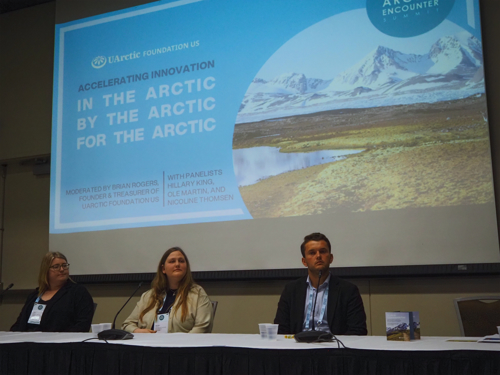 Three panelists - Photo by Laura Ditto