
Student report from UArctic Congress 2026: Lena Leimgruber Haraldsson

Lena Leimgruber Haraldsson, a second-year PhD student in English Literature at Umeå University in Sweden, received a UArctic Student Travel Grant to support her participation in the Congress. She shares her experiences here.
I am a second-year PhD student in English Literature at Umeå University (Sweden) working in the field of literary studies and environmental humanities. My research explores Arctic literature and speculative narratives through the lens of the environmental humanities, with particular attention to colonial histories, climate change and Indigenous and local knowledge systems. I received a UArctic Student Travel Grant to support my participation in the Congress.
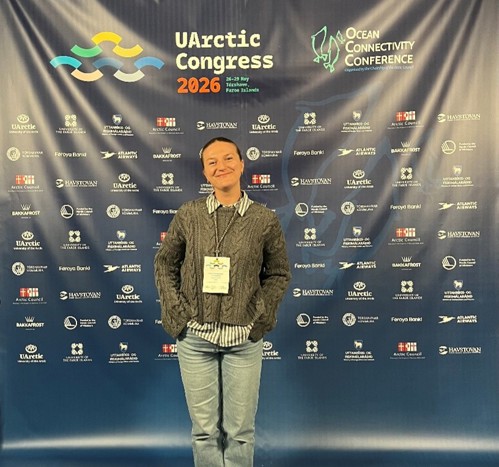
During the Congress, I was actively involved in different programmes. Primarily, I was there thanks to the Environmental Humanities UArctic Thematic Network. The network has been instrumental in shaping my academic development. An in-person network meeting was held on Monday prior to the Congress.
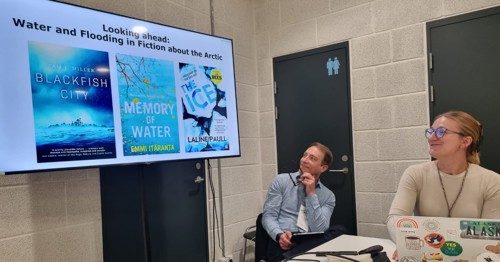
Secondly, I presented in session 162, When the waters came: Building resilience to flooding in Arctic communities through flood myths and stories, where I presented research closely connected to my PhD project. My presentation focused on how the Arctic functions as a “last frontier” in the novel after catastrophic global flooding has reshaped the world. The session led to a very engaging discussion among the speakers and audience members. One of the other presentations discussed Dark Matter, a novel that is also relevant to my PhD research and that we have previously used in teaching.
On Thursday, I presented a poster on young adult fiction set in the Arctic. The focus of the poster was to invite non-literature scholars to get to know some examples of literary fiction that depict speculative futures of the climate-changing Arctic for young readers.
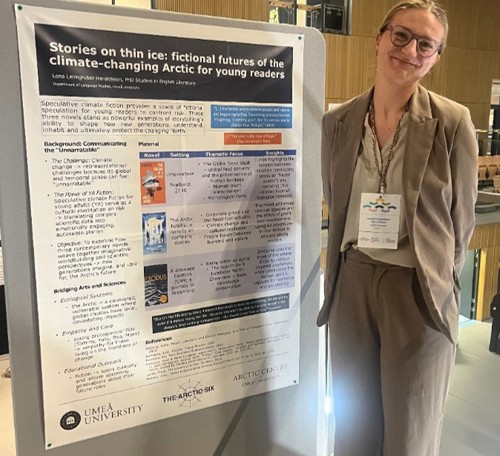
Presenting in poster format proved to be a good way of initiating conversations across disciplinary boundaries. The visual format attracted researchers from a wide range of fields, including those who might not normally attend literature-focused sessions, and created opportunities to discuss how fiction contributes to public understandings of Arctic futures, climate change and environmental transformation. These conversations highlighted the value of literary studies within broader Arctic research and demonstrated how narratives can complement scientific, social scientific and policy-oriented perspectives. The poster also provided an opportunity to represent the humanities (particularly literary studies) in a format less commonly used within the field. As poster presentations often are associated with the natural and social sciences, presenting literary research in this way encouraged interdisciplinary dialogue about the role of stories and cultural representation in shaping understandings of the Arctic.
Last but not least, I co-organised Session 6, Creating and Communicating Arctic ArtScience, together with Lilli Mittner, Filip Maric, and Kate Maxwell. The session brought together nine scholars and practitioners working at the intersection of artistic practice, scientific research, and public engagement in Arctic contexts. The contributions spanned a range of methods and geographies, highlighting the diversity of approaches within ArtScience practices and Arctic research communication. There are plans to develop the session into a collaborative publication.
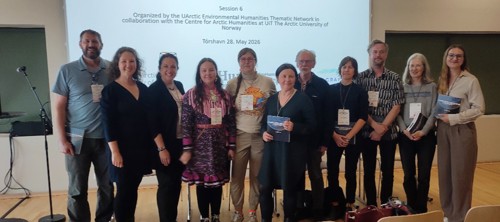
I also moderated the session, which I found particularly rewarding. In my role as moderator, I aimed to actively build bridges between the different speakers by drawing attention to connections across their geographies, methods and thematic concerns. This included linking artistic and scientific approaches as well as highlighting shared conceptual threads across otherwise diverse presentations. I very much enjoyed facilitating this exchange and supporting a coherent dialogue across the session, and I hope to continue engaging in similar moderating roles in future conferences and collaborative settings.
The above-mentioned things obviously feel like big accomplishments. The Congress also enabled significant networking and institutional engagement. These interactions opened new possibilities for collaboration and provided useful insight into future publication strategies. Moreover, participating in a congress with approximately 1400 attendees was a significant professional experience, offering an unusually broad international platform for exchange and making it possible to engage directly with a large and diverse Arctic research community. The discussions, presentations and networking opportunities have generated several concrete follow-up directions, including potential collaborations with colleagues based in Greenland and Hull, as well as ongoing conversations about integrating literary studies perspectives into existing Arctic-focused courses and teaching initiatives. In addition, the Congress has provided inspiration for future academic engagement and event organisation, particularly in relation to how large-scale interdisciplinary gatherings can be structured to facilitate meaningful exchange across disciplines. Looking ahead, I am also excited about the next UArctic Congress, which will take place in Umeå, as it offers further opportunities for collaboration, possible participation in organisational roles and ideas for contributing to making the next Congress an equally engaging and memorable event. Overall, the experience has significantly strengthened both my research network and my sense of direction within Arctic humanities scholarship.
Lena's grant was funded by the Nordic Council of Ministers.